
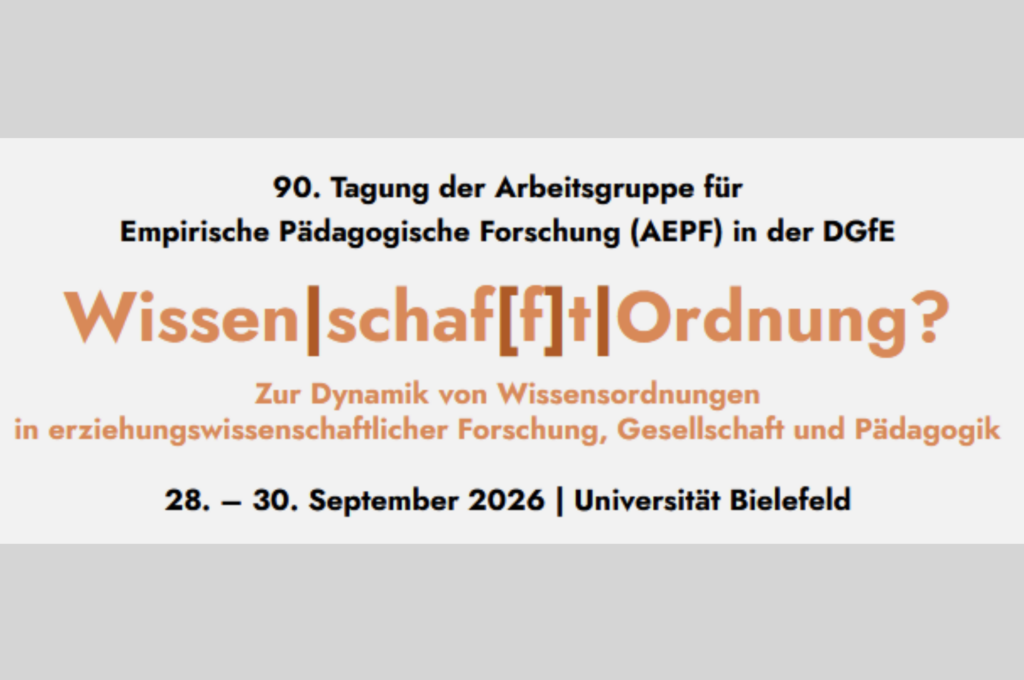
From September 28 to 30, 2026, the 90th conference of the Working Group for Empirical Educational Research (AEPF) took place at Bielefeld University. Under the conference theme “Does Knowledge Create Order? – On the Dynamics of Knowledge Structures in Educational Research, Society, and Pedagogy,” the Chair of School Pedagogy, with a focus on empirical classroom research, was represented by four research presentations.
AI-Based Feedback in Teacher Education
Florian Hofmann, Tina-Myrica Daunicht, Lea Plößl, and Michaela Gläser-Zikuda investigated the potential of AI-generated feedback for the reflective abilities of pre-service teachers. The study presented compared feedback from instructors and ChatGPT and discussed its quality and significance for the further development of written reflections.
Caring, Emotions, and Work Engagement in the Teaching Profession
Berit Breins and Michaela Gläser-Zikuda presented a study on teachers’ caring profiles. The focus was on different approaches to shaping supportive teacher-student relationships and their connections to emotions and work engagement. The results show differences between the identified profiles, particularly with regard to joy and work engagement. The relevance and broader implications of the findings were discussed in the presentation.
School Alienation from a Network Perspective
Michaela Gläser-Zikuda, Berit Breins, and Ann-Kathrin Quarda examined central and connecting elements of school alienation in lower secondary school. The combination of network analyses and qualitative findings placed particular emphasis on the perceived meaningfulness of learning and relationships with teachers. Based on this, potential starting points for preventing school alienation were discussed.
School Well-Being, School Alienation, and Aggressive Behavior
Meike Wagner, Berit Breins, and Michaela Gläser-Zikuda examined the relationships between school well-being, school alienation, and aggressive behavior. The paper combined quantitative analyses with group interviews and highlighted the importance of social relationships and school experiences for understanding aggressive behavior.
The papers offered different perspectives on the quality of pedagogical relationships, emotional experiences at school, and the professional development of teachers.